
Indo-European had the following sounds:
Consonants: p, t, k, kw; b, d, g, gw; bh, dh, gh, gwh; s;
m, n; r; l; y, w
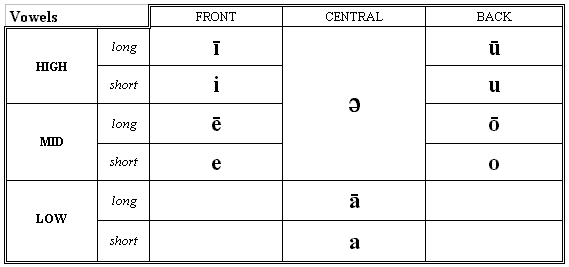
Vowels: i, e, a, o, u,
ī, ē,
ā, ō, ū, «
The nasals and liquids [m, n, r, l] could be either
syllabic or nonsyllabic.
Following the symbol for a stop, h indicates aspiration and w indicates that the
stop was pronounced with rounded lips.
The macron over a vowel indicates primarily length rather than a
qualitative difference.
Otherwise, the symbols have their usual phonetic value. Obviously the exact
pronunciation of Indo-European is a matter of conjecture, thus other reconstructions are possible.
Indo-European at one time had several other
phonemes, “laryngeals” the exact number and quality of which are uncertain,
although they were presumably fricatives of some kind. They were lost early in
the Indo-European period.
The charts below show the articulatory classification of the Indo-European sounds.
* Source:
Britannica.com